
Into the Hellscape Project
If they don't need us, do we need them?

Editors note—Something a little unusual this time! Usually, Saxon & Sam think and write collaboratively to produce this Substack. Sometimes it’s driven by one or the other of us, but it’s usually pretty ideationally equitable. Our last edition, however, was mostly written by Sam. Saxon drafted a lengthy P.S., which instead of trying to cram in, we’ve decided to share as a stand alone.
If you haven’t read part one — make sure to check out “What We Lose When We Lose the Culture Industries” here.
It seems logical to be suspicious of the current slide into a media hellscape from digital platforms to film and television that is being created and reshaped at the hands of billionaires. Particularly, ones with sets of specific ideologies around how society should be structured and the future of humanity in the not-so-distant future. Yet, some of the current “sky-is-falling” claims made about their impact can seem a bit…methodologically naive? Or at least worth taking a close look at. That is to say, it feels important to question how successful the billionaire’s transmission of these ideologies (dreams or visions of the good life, as Sam puts it) could be in a lot of these worst case scenarios—especially if they do, indeed, ignore any feedback from the American people.
I suppose the answer partly depends on one’s trust in the consumer’s discernment and willingness to find media alternatives, turn it off, and/or go touch some grass before mass dopaminergic brain damage ruins any potential for any real alterity to the contemporary moment. (And of course, the question about whether there is really any possibility for “alternative” media streams is very real…especially because so many of those supposedly independent streams are still operating within the Meta platforms, and therefore, within the overall ambit of their algorithmic systems).
But even then, the efficacy of what we might term the “Billionaire Hellscape Project” (HSP) still has to deal with—and indeed, is in many ways formulated around—the niche, fractured, atemporal nature of the contemporary media landscape. While these dynamics are very much rotting our brains, they might also reduce the potential influence of any one channel or set of channels. 1950s (or…1930s) style mass media…just doesn’t exist like that anymore. Ironic that the very beast Zuck and Friends created has (potentially?) led to greater access to different visions of how society can be formed. But does it stop there, access and nothing else? Stuck in the stasis of Discord chats where avatar identities gesture toward never-fully-realized micropolitical views or a predilection for a new kind of “tune in, turn on and drop out?” Or can it lead to a kind of organization (or even mass negation) against the still-powerful formulations of mass media that would render them (and their pseudo-propagandist visions and ideologies wrapped inside the Marvel-esque series it broadcasts) relatively irrelevant (though perhaps always prevalent, Tyrell and Co.-style)?
After all, activism is up, apparently.
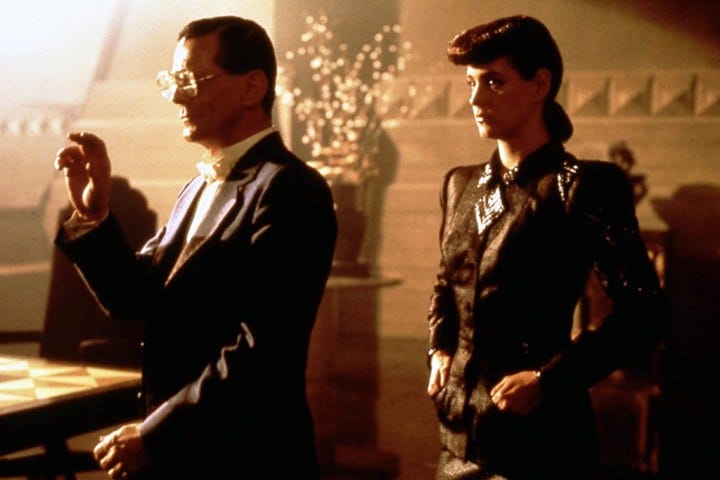
Irregardless, a question underpins all my crystal ball viewing: if as Sam argues, an Oracle (or other similarly thirsty billionaires) owned and operated version of these media companies didn’t need to turn a profit in the same way that they traditionally have, and, as a result, the desires and wants of the viewer (regardless of how mediated that is already) lessens, then why do we, as viewers need them in return? Does the lack of libidinal back-and-forth that the switch to Pure Propaganda Mode entails lessen the efficacy of whatever the our new class of Billionaires are trying to transmit? Would it alter their ability to maintain hegemony—which, as we all know, requires at least a degree of buy-in from the the overall structures, including those at the bottom? If people don’t want what their consuming, does it really mean the same thing?
It’s an open question that doesn’t negate Sam’s concerns, nor does it considers the impact of individualized sites of labor (your bedroom) that this fractured media landscape begets and the very real impact that has to any kind resistance to our on-coming purely AI generated hell. But a return to a consolidated three-channel world, run by a whole other set of wealthy elite with their own ideas, doesn’t seem necessarily to be something to outright lament either. And it’s worth wondering if the long-held presupposition that those holding the money bag don’t need us to continue to contribute to that bag anymore, then does that not, in part, weaken their influence and power over transmitting their ideas over us?
The darker conclusion (and perhaps most likely) is that the answer is yes, it does weaken their influence over us, but that this doesn’t matter either. That we are also past the point of where any kind of convincing of the general public is rendered irrelevant in this seemingly fast approaching neo-oligarchical state we are careening towards like that 2012 Icona Pop hit.
Department of Actual Music:
Sam: GET FREAKING PONIED. I know I’m probably late to the party, but the mixture of endless-internet lore, deeply personal narrative via complex my little pony story building, absolutely insane skrillex wubs, and post-new-metal post-emo screams is…well it’s a lot. But I like it.
Saxon: Not to be the “I was there” guy, but a few years ago when I was still a resident in Atlanta, I had the joy of seeing Sword II play in converted motorcycle garage in a very sketchy part of town. It was their debut album release and I felt I had seen the coming of a Gen-Z Sonic Youth. I wrote about them for Bandcamp later, but the buzz that followed seemed pretty tame. Not anymore. The group seems to be getting all the love and publicity they deserve now. The new album Electric Hour is natural evolution from their woozy, post-shoegazey, grungified-pop and I already have it on repeat. Also, bonus points for reppin’ ATL so hard and that they haven’t run off to NYC or the West Coast (yet).
Saxon and Sam